The digital age has irrevocably transformed consumer behavior, creating an insatiable demand for speed, convenience, and transparency in online shopping. At the heart of this e-commerce revolution lies a critical and complex challenge: the last-mile delivery. This final leg of the journey, where a package travels from a local distribution hub to the customer’s doorstep, is the most expensive, inefficient, and carbon-intensive part of the entire supply chain. It represents the ultimate bottleneck and the final frontier in the race for customer satisfaction. Consequently, revolutionizing last-mile delivery services is no longer a luxury for forward-thinking businesses; it has become an absolute necessity for survival and growth in the hyper-competitive global marketplace. This in-depth exploration will dissect the multifaceted strategies, cutting-edge technologies, and innovative business models that are fundamentally reshaping last-mile logistics for a new era.
Understanding the Last-Mile Delivery Conundrum
To appreciate the revolution, one must first understand the scale of the problem. The “last-mile” is a logistical nightmare characterized by a unique set of challenges that differentiate it from long-haul freight or warehouse management.
A. Prohibitive Costs: Surprisingly, last-mile delivery can account for a staggering 53% of the total shipping cost. This is driven by factors like low drop sizes (few packages per stop), labor expenses for drivers, fuel costs, and the time spent navigating complex urban environments.
B. Inefficiency and Traffic Congestion: Delivery vehicles often contribute to and are hampered by inner-city traffic congestion. Finding parking, navigating narrow streets, and dealing with road closures can turn a theoretically simple delivery into a time-consuming ordeal, reducing the number of deliveries a driver can complete per hour.
C. The “Not Home” Problem: Failed deliveries are a massive drain on resources. When a customer isn’t home to receive a package, the driver must either attempt re-delivery (incurring more costs) or leave the parcel in an unsecured location, risking theft a phenomenon known as “porch piracy.”
D. Elevated Customer Expectations: Modern consumers, conditioned by giants like Amazon, demand near-instant gratification. They expect free, fast, and fully transparent shipping with real-time tracking and flexible delivery windows. Meeting these expectations without exploding costs is the central puzzle of last-mile logistics.
E. Environmental Impact: The prevalence of gas and diesel-powered vehicles making countless individual stops creates a significant carbon footprint. As sustainability becomes a key concern for both consumers and corporations, reducing this environmental impact is a priority.
Pioneering Technologies Driving the Last-Mile Revolution
Innovation is tackling these challenges head-on. A suite of advanced technologies is being deployed to optimize routes, enhance efficiency, and create new delivery paradigms.
A. Artificial Intelligence and Machine Learning
AI and ML are the brains behind the modern last-mile operation. These technologies analyze vast datasets including historical traffic patterns, weather conditions, order volume, and real-time road events to predict optimal delivery routes. This goes beyond simple GPS navigation; it involves dynamic routing that can adjust in real-time if a traffic jam occurs or if a new, higher-priority order is placed. AI also powers predictive analytics, forecasting demand in specific neighborhoods to pre-position inventory in micro-fulfillment centers, drastically cutting down delivery distances and times.
B. Autonomous Vehicles and Robots
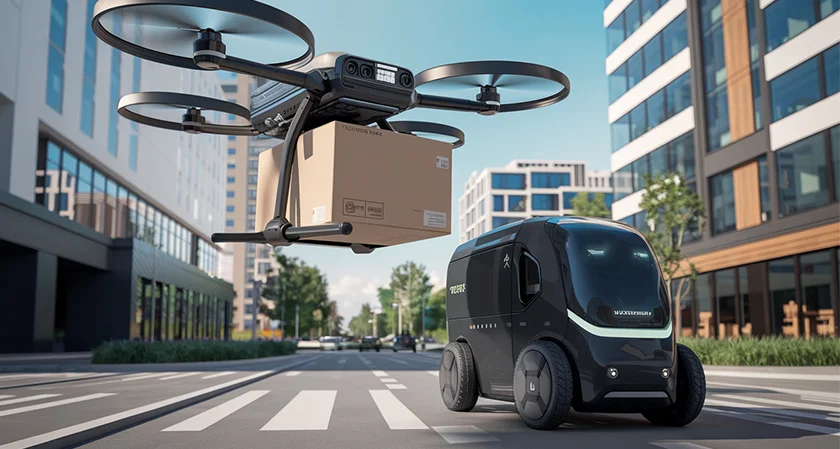
The vision of self-navigating delivery systems is rapidly moving from science fiction to reality.
-
Delivery Drones: Unmanned Aerial Vehicles (UAVs), or drones, offer the potential for ultra-fast aerial deliveries, bypassing ground traffic entirely. They are ideal for urgent deliveries of small, high-value items like medicines or documents in both urban and hard-to-reach rural areas. Companies like Zipline are already using them effectively for medical supply delivery in Africa.
-
Self-Driving Vans and Cars: Companies like Waymo and Nuro are developing autonomous vehicles designed specifically for package delivery. These vehicles could operate 24/7, reducing labor costs and increasing delivery capacity. They promise a future where a fleet of driverless vehicles handles routine deliveries efficiently.
-
Sidewalk Robots: These compact, autonomous robots, such as those from Starship Technologies, navigate sidewalks to deliver groceries and meals within a small radius. They represent a zero-emission solution for localized delivery needs.
C. The Internet of Things (IoT)
IoT connects physical objects to the internet, creating a web of data throughout the delivery chain. Smart sensors placed in packages can monitor location, temperature, humidity, and even shock. This provides unparalleled transparency, allowing both the company and the customer to know the exact condition and location of a delivery. Smart locks (e.g., Amazon Key) allow delivery drivers one-time secure access to a customer’s garage or trunk to place packages safely, eliminating failed deliveries.
D. Advanced Data Analytics and Cloud Computing
The power to process the immense amount of data generated by AI, GPS, and IoT sensors resides in the cloud. Cloud-based delivery management platforms provide a unified view of the entire fleet, enabling dispatchers to manage orders, track drivers, and communicate with customers seamlessly. This data-driven approach allows for continuous improvement by identifying inefficiencies and benchmarking performance.
Innovative Delivery Models and Strategies

Beyond technology, new operational models are emerging to complement and enhance technological solutions.
A. Leveraging Crowdsourced Delivery Networks
Platforms like Uber Eats, DoorDash, and Deliv have pioneered the “gig economy” model for delivery. These services use a network of independent contractors (using their own vehicles) to pick up and deliver packages on demand. This model offers immense scalability during peak periods (like holidays) without the fixed cost of maintaining a large permanent fleet of drivers and vehicles. It provides flexibility and can quickly expand coverage to new areas.
B. The Proliferation of Pickup Points and Lockers
To combat the “not home” problem, secure pickup points and automated locker banks (e.g., Amazon Locker) have become increasingly popular. These are strategically placed in convenient locations like grocery stores, gas stations, and transit hubs. Customers can collect their parcels at their leisure, often 24/7. This model allows drivers to drop off multiple packages at a single location, dramatically increasing their efficiency and reducing failed delivery attempts.
C. Micro-Fulfillment Centers and Dark Stores
The old model of shipping from massive, centralized warehouses hundreds of miles away is too slow for modern demands. The new strategy involves deploying a network of small, hyper-local warehouses known as micro-fulfillment centers or “dark stores” (retail stores that are closed to the public and used only for online order fulfillment). By storing inventory within the urban core, companies can slash delivery times from days to hours, enabling same-day and even one-hour delivery promises.
D. Sustainable and Eco-Conscious Delivery Options
The green revolution is a key part of last-mile innovation. Companies are increasingly electrifying their delivery fleets with electric vans, cars, and e-bikes to eliminate tailpipe emissions. Centralized pickup points and optimized routing also contribute to a lower carbon footprint by reducing the total distance traveled per package. Furthermore, many companies are offering “green” delivery slots, where customers can choose a slower delivery option that allows the company to consolidate orders into a more efficient route, often in exchange for a discount or loyalty points.
The Critical Role of Software and Optimization
The hardware of delivery is nothing without the software that orchestrates it. Last-mile delivery software is the central nervous system that integrates all these elements.
-
Route Optimization Algorithms: This is the core function. Advanced software calculates the most efficient sequence of stops, considering countless constraints like time windows, vehicle capacity, driver working hours, and real-time traffic.
-
Dynamic Scheduling: Allows for real-time order allocation. If a new order comes in, the system can instantly assign it to the most appropriate driver based on their current location and route.
-
Proof of Delivery (POD): Digital POD through mobile apps has replaced paper receipts. Drivers can capture signatures, take photos of the delivered parcel, and instantly update the status, providing immediate confirmation to the customer.
-
Customer Communication: Automated SMS and email alerts keep customers informed at every step—from order confirmation to “out for delivery” notifications and a final delivery confirmation. This transparency reduces anxiety and costly customer service inquiries.
The Human Element: Enhancing the Driver and Customer Experience

Technology should empower people, not replace them. The driver remains a crucial touchpoint.
A. Driver Empowerment: Modern delivery apps provide drivers with optimized routes and easy navigation, reducing stress and saving time. Features like digital proof of delivery and integrated communication tools simplify their workflow and make them more efficient.
B. The Customer-Centric Approach: The entire revolution is geared toward the end customer. Flexibility is key. Customers now expect a range of options: the ability to choose a specific two-hour delivery window, reroute a package to a neighbor or a locker while it’s in transit, or provide specific delivery instructions through a portal. This level of control is becoming standard.
Gazing into the Future: What’s Next for Last-Mile Delivery?
The revolution is ongoing, and the future holds even more transformative possibilities.
A. Hyperlocal Delivery Networks: The rise of ultrafast (15-minute) grocery delivery apps like Gorillas and Getir is signifying a move towards hyperlocal networks, relying entirely on dark stores within neighborhoods.
B. Advanced Automation: We will see wider adoption of autonomous delivery vehicles and drones, likely starting in controlled communities and campuses before expanding to entire cities. Regulatory frameworks will be the key factor governing their speed of adoption.
C. Predictive Logistics: AI will become so advanced that it will anticipate orders before they are even placed. Based on a customer’s purchase history, local events, and even weather forecasts, products could be pre-positioned in micro-fulfillment centers, making “instantaneous” delivery a reality.
D. Biometric and Contactless Delivery: For high-security deliveries, biometric verification (a fingerprint or facial scan) could become the standard proof of delivery. Contactless drop-off, accelerated by the COVID-19 pandemic, will remain a preferred option.
Conclusion: The Final Mile is the First Priority
The last-mile delivery segment has evolved from a logistical afterthought to the most critical component of the customer experience. Revolutionizing it is a complex dance of integrating groundbreaking technology from AI and drones to IoT with smart operational models like crowdsourcing and micro-fulfillment. The businesses that succeed in mastering this revolution will be those that view the last mile not as a cost center to be minimized, but as a strategic opportunity to be maximized. By investing in solutions that prioritize efficiency, transparency, sustainability, and unparalleled customer choice, companies can transform this final hurdle into their greatest competitive advantage, securing loyalty and driving growth in the ever-evolving world of e-commerce.